
How to Decode Mercury Outboard Model Codes: A Simple Guide to Engine Letters and Features

Why Mercury Outboard Model Codes Matter
Two Mercury outboards can have the same horsepower but be configured very differently.
For example, one 20-horsepower Mercury outboard may have:
- Manual starting
- A tiller handle
- A 15-inch shaft
- Manual trim
Another 20-horsepower model may feature:
- Electric starting
- Remote steering
- A 20-inch shaft
- Power trim
Although both engines produce the same rated horsepower, they are intended for different boats and operating requirements.
The model code helps identify those differences before you purchase the engine.
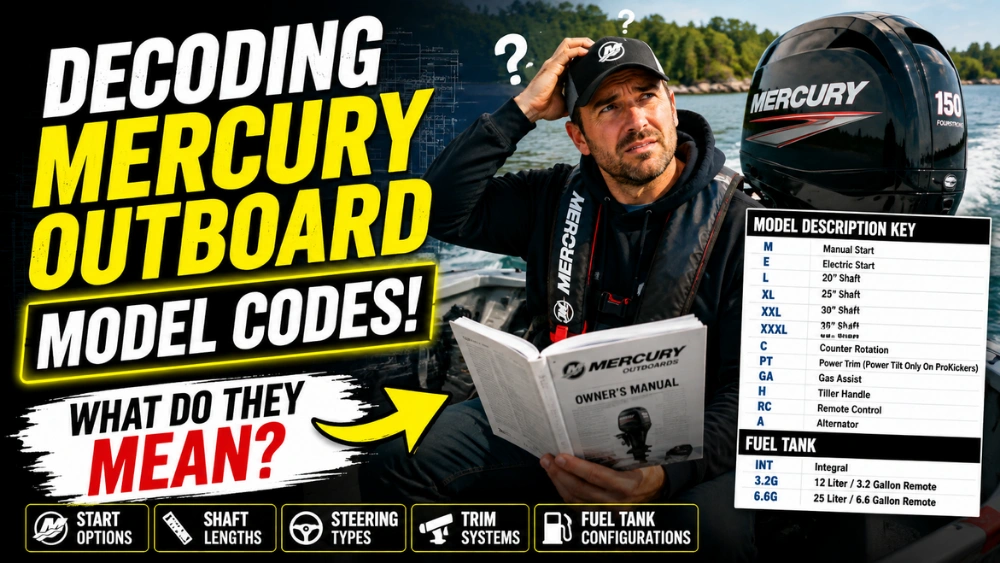
Mercury Outboard Model Description Key
Here are the main abbreviations shown in the Mercury model-description chart.
M — Manual Start
The letter M identifies a manual-start outboard.
A manual-start engine uses a pull-start system rather than an electric starter. Manual starting is commonly found on smaller portable outboards, fishing boats, utility boats and tenders.
Example: Mercury 9.9MH
- 9.9: 9.9 horsepower
- M: Manual start
- H: Tiller handle
This would describe a 9.9-horsepower Mercury outboard with manual starting and tiller steering.
Manual-start models can be appealing to boaters who want a straightforward portable engine without requiring a dedicated starting battery.
E — Electric Start
The letter E means the outboard is equipped with electric starting.
Instead of pulling a starter cord, the operator starts the engine with a key, button or control-system switch, depending on the installation.
Example: Mercury 20ELH
- 20: 20 horsepower
- E: Electric start
- L: 20-inch shaft
- H: Tiller handle
This model would be a 20-horsepower Mercury outboard with electric starting, a 20-inch shaft and tiller steering.
Electric start is particularly useful for frequent operation, larger engines or boaters who want greater convenience.
Mercury Outboard Shaft-Length Codes
Choosing the correct shaft length is essential. An outboard with the wrong shaft length can affect performance, handling, cooling-water flow and propeller efficiency.
Mercury model codes commonly identify shaft length using the following letters.
L — 20-Inch Shaft
The letter L represents a 20-inch shaft, often called a long-shaft outboard.
Example: Mercury 15ELH
- 15: 15 horsepower
- E: Electric start
- L: 20-inch shaft
- H: Tiller handle
This configuration may suit many fishing boats, utility boats and aluminum boats designed for a 20-inch transom.
XL — 25-Inch Shaft
The letters XL identify a 25-inch shaft.
Extra-long-shaft outboards are commonly used on boats with taller transoms, including many larger fishing boats, pontoons, offshore boats and fibreglass vessels.
Example: Mercury 150XL
- 150: 150 horsepower
- XL: 25-inch shaft
The remaining steering, starting and trim features may be standard for that engine family or explained elsewhere in the complete product description.
XXL — 30-Inch Shaft
The letters XXL represent a 30-inch shaft.
This length is commonly used on larger boats, deep-transom applications and certain multiple-engine installations.
Example: Mercury 300XXL
- 300: 300 horsepower
- XXL: 30-inch shaft
A 30-inch-shaft engine should only be installed when it matches the boat manufacturer’s specified transom and engine configuration.
XXXL — 35-Inch Shaft
The letters XXXL identify a 35-inch shaft.
These engines are generally intended for specialized, high-transom and multi-engine marine applications.
Example: Mercury 400XXXL
- 400: 400 horsepower
- XXXL: 35-inch shaft
Because these installations are highly specialized, engine selection and rigging should be confirmed by an experienced Mercury dealer.
C — Counter Rotation
The letter C means counter rotation.
Counter-rotating engines are used primarily in twin-, triple- or multiple-outboard installations. One propeller rotates in the opposite direction from another, helping balance steering forces and improve handling.
Example: Mercury 150CXL
- 150: 150 horsepower
- C: Counter rotation
- XL: 25-inch shaft
This could be paired with a corresponding standard-rotation engine in a twin-outboard installation.
Counter-rotation requirements depend on the boat, gearcase, engine position and rigging plan. A Mercury dealer should confirm the correct engine for each mounting position.
PT — Power Trim
The abbreviation PT means power trim.
Power trim allows the operator to adjust the engine’s angle while underway. Correct trim can improve:
- Acceleration
- Fuel efficiency
- Boat attitude
- Ride comfort
- Top-end performance
- Handling in changing water conditions
Power tilt also makes it easier to raise the engine when trailering, docking or operating in shallow water.
Example: Mercury 20ELPT
- 20: 20 horsepower
- E: Electric start
- L: 20-inch shaft
- PT: Power trim
This model would have electric starting, a 20-inch shaft and power trim.
On certain Mercury ProKicker models, the PT designation may refer to power tilt only, as noted in the model-description chart.
GA — Gas Assist
The letters GA mean gas assist.
Gas-assist systems help the operator tilt the outboard by reducing the physical effort required. It is not the same as fully powered electric trim.
Example: Mercury 15MLHGA
Depending on how the complete model is presented, the description may indicate:
- 15: 15 horsepower
- M: Manual start
- L: 20-inch shaft
- H: Tiller handle
- GA: Gas-assisted tilt
Gas assist can be useful for portable or mid-sized outboards where the operator wants easier manual tilting without a complete power-trim system.
H — Tiller Handle
The letter H identifies a tiller-handle outboard.
A tiller handle allows the operator to steer, control the throttle and operate the engine directly from the outboard.
Tiller models are popular for:
- Aluminum fishing boats
- Utility boats
- Hunting boats
- Work boats
- Tenders
- Small pontoons
- Back-trolling applications
Example: Mercury 25ELHPT
- 25: 25 horsepower
- E: Electric start
- L: 20-inch shaft
- H: Tiller handle
- PT: Power trim
This configuration combines tiller control with electric starting and power trim.
The exact order of the letters can vary by engine family or listing, so always read the complete product description rather than relying only on letter position.
RC — Remote Control
The abbreviation RC means remote control.
Remote-control outboards are operated from a helm using a steering wheel and separate throttle-and-shift controls.
This arrangement is common on:
- Console fishing boats
- Pontoons
- Runabouts
- Fibreglass boats
- Larger aluminum boats
- Centre-console boats
A remote-control engine may require additional rigging components, including controls, cables, steering equipment, gauges, harnesses and a compatible propeller.
Example: Mercury 25ELPTRC
The code may indicate:
- 25: 25 horsepower
- E: Electric start
- L: 20-inch shaft
- PT: Power trim
- RC: Remote control
Some Mercury listings may not display “RC” in the abbreviated consumer-facing model name, even when the engine is designed for remote control. Always review the complete engine specifications.
A — Alternator
The letter A means the outboard includes an alternator or charging capability.
An alternator helps replenish the boat’s battery while the engine is running. This can support equipment such as:
- Navigation lights
- Fish finders
- Marine electronics
- Bilge pumps
- Communication equipment
- Starting batteries
Example: Mercury 9.9MLHA
The code could indicate:
- 9.9: 9.9 horsepower
- M: Manual start
- L: 20-inch shaft
- H: Tiller handle
- A: Alternator
Charging output varies by model, engine speed and electrical configuration. Check the detailed Mercury specifications for the engine’s rated output.
How to Decode a Complete Mercury Outboard Model Code
Consider the example:
Mercury 20ELHPT
Breaking it down:
- 20 means 20 horsepower
- E means electric start
- L means a 20-inch shaft
- H means tiller handle
- PT means power trim
In plain language, this would be described as:
A 20-horsepower Mercury outboard with electric starting, a 20-inch shaft, tiller steering and power trim.
Now consider:
Mercury 150CXL
- 150 means 150 horsepower
- C means counter rotation
- XL means a 25-inch shaft
In plain language:
A 150-horsepower, counter-rotating Mercury outboard with a 25-inch shaft, intended for an appropriate multiple-engine installation.
Another example:
Mercury 9.9MH
- 9.9 means 9.9 horsepower
- M means manual start
- H means tiller handle
In plain language:
A portable 9.9-horsepower Mercury outboard with manual starting and tiller steering.
Understanding Mercury Fuel-Tank Codes
The chart also includes abbreviations related to the fuel-tank system.
INT — Integral Fuel Tank
INT means the fuel tank is built into the outboard.
Integral tanks are often found on small portable engines. They can make the engine more convenient to transport and operate because a separate fuel tank may not be necessary for short trips.
3.2G — 12-Litre Remote Fuel Tank
The code 3.2G identifies a remote fuel tank with approximately:
- 12 litres
- 3.2 US gallons
A remote tank connects to the outboard with a fuel hose and can normally be positioned inside the boat where appropriate.
6.6G — 25-Litre Remote Fuel Tank
The code 6.6G identifies a larger remote fuel tank with approximately:
- 25 litres
- 6.6 US gallons
This larger tank can provide greater operating range, depending on the engine, boat, load, speed and water conditions.
What Does It Mean When a Shaft Letter Is Missing?
The chart identifies:
- L as 20 inches
- XL as 25 inches
- XXL as 30 inches
- XXXL as 35 inches
On many smaller outboard listings, the absence of one of these shaft codes may indicate a standard 15-inch configuration. However, model naming can differ across Mercury product families and model years.
Never assume the required shaft length based on the code alone. Confirm the boat’s transom height and the engine’s published specifications before purchasing.
How to Choose the Correct Mercury Outboard
Decoding the model number is only one part of selecting an engine. Before buying, consider:
Your Boat’s Horsepower Rating
Never exceed the maximum horsepower shown on the boat’s capacity plate or specified by the manufacturer.
Transom Height
The engine’s shaft length must match the boat’s transom design. An incorrect match can reduce performance and create handling or cooling concerns.
Tiller or Remote Steering
Choose a tiller model for direct engine control or a remote model for helm steering.
Manual or Electric Start
Manual starting offers simplicity, while electric starting provides convenience.
Power Trim Requirements
Power trim can significantly improve operation, especially on larger boats, changing loads and varying water conditions.
Rigging Components
The engine price may not include every component required for installation. Depending on the model, you may also need:
- Control box
- Control cables
- Steering system
- Wiring harness
- Gauges or display
- Battery
- Fuel system
- Propeller
- Mounting hardware
A properly matched and professionally rigged outboard provides better performance, safety, reliability and long-term ownership satisfaction.
Shop Mercury Outboards, Parts and Accessories at Energy Powersports
For all things Mercury Marine, visit Energy Powersports in Oakville, Ontario.
Whether you need a new Mercury outboard, maintenance products, propellers, rigging components, accessories or genuine marine parts, the Energy Powersports team can help you identify the correct product for your boat and engine.
Best of all, Energy Powersports sells Mercury outboard engines online, making it easier to browse and purchase the right engine from wherever you are.
Shop online 24 hours a day, 7 days a week at:
https://shop.energypowersports.ca
You can also visit Energy Powersports in person:
Energy Powersports
879 Cranberry Court
Oakville, Ontario
905-901-5500
From portable fishing-boat engines to larger Mercury outboards, parts, accessories, oils and marine equipment, shop.energypowersports.ca is your go-to Canadian destination for all things Mercury.
Frequently Asked Questions About Mercury Outboard Model Codes
What does “E” mean on a Mercury outboard?
The letter E means the engine has electric starting.
What does “M” mean?
The letter M identifies a manual-start engine.
What does “L” mean?
The letter L means the outboard has a 20-inch shaft.
What does “XL” mean?
XL identifies a 25-inch shaft.
What does “PT” mean?
PT usually means power trim. On certain ProKicker models, it may indicate power tilt only.
What does “H” mean?
The letter H means the outboard is equipped with a tiller handle.
What does “C” mean?
The letter C identifies a counter-rotating engine, normally used in multiple-outboard installations.
Can I buy Mercury outboard engines online in Canada?
Yes. Energy Powersports sells Mercury outboard engines online through https://shop.energypowersports.ca, along with Mercury parts, accessories, maintenance products and marine equipment.
Model-code formats, included equipment and feature availability can vary by engine family, horsepower, market and model year. Always confirm the complete Mercury product specifications and compatibility before ordering.
