
What Are Smart-Shox? A Complete Guide to Can-Am and Ski-Doo Semi-Active Suspension

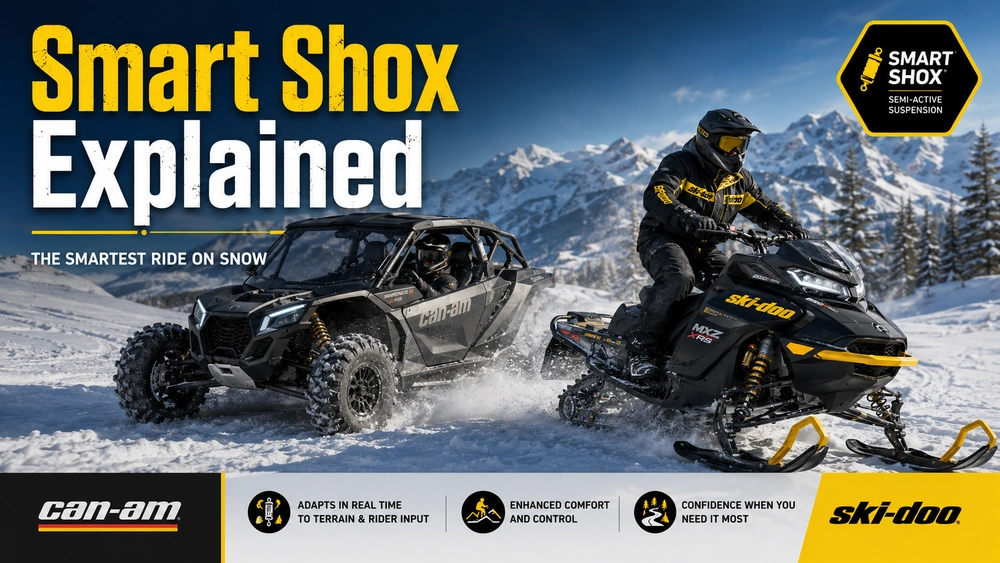
Instead of forcing the rider to stop and manually adjust every shock as conditions change, Smart-Shox evaluates vehicle movement and rider input, then electronically adjusts the suspension in real time.
What Are Smart-Shox?
Smart-Shox are electronically controlled shock absorbers that automatically adapt their damping to the terrain, speed, chassis movement and rider inputs.
In simple terms, the system can make the suspension feel softer when comfort and traction are needed, then firm it almost instantly when the vehicle encounters a large impact, aggressive corner, hard acceleration or sudden braking.
The objective is to deliver three major advantages:
-
Greater comfort over rough and changing terrain
-
Better chassis control during aggressive riding
-
Less need for manual suspension adjustment
Smart-Shox do not replace the vehicle’s springs or suspension arms. They control how quickly the shocks compress and rebound as the suspension moves.
How Do Smart-Shox Work?
A Smart-Shox system generally includes:
-
Electronically controlled shock absorbers
-
Suspension-position and vehicle-motion sensors
-
A dedicated electronic control module
-
Vehicle speed, throttle and steering information
-
Specialized software and suspension calibration
-
Selectable riding modes
As the vehicle moves, its sensors monitor what the chassis and suspension are doing. The electronic control module analyzes that information and sends commands to valves inside the shocks.
These valves change the amount of damping force being produced.
When the system detects small trail chatter or uneven ground, it can reduce damping to help the wheels move more freely and absorb the terrain.
When it detects a large bump, hard landing, rapid weight transfer or aggressive corner, it can increase damping to help prevent excessive suspension movement.
The process occurs continuously, allowing the suspension to adapt several times during a single section of trail.
What Does “Semi-Active Suspension” Mean?
Smart-Shox is described as a semi-active suspension because it changes shock damping electronically, but it does not actively lift the vehicle or move the wheels using hydraulic or electric actuators.
The springs still support the weight of the vehicle, while the suspension arms, rails and other mechanical components still control wheel or skid movement.
The electronic system manages damping force within the shocks.
That distinction matters because semi-active suspension can provide rapid electronic adjustment without the weight and complexity of a fully active automotive suspension.
Compression Damping Versus Rebound Damping
Understanding Smart-Shox becomes easier when compression and rebound are considered separately.
Compression damping
Compression damping controls how quickly a shock compresses when the wheel, ski or suspension encounters an obstacle.
More compression damping can help resist:
-
Bottoming on large bumps
-
Excessive body roll
-
Front-end dive under braking
-
Rear-end squat during acceleration
-
Harsh chassis movement during aggressive riding
Less compression damping can help the suspension move more easily over small bumps, roots, rocks and trail chatter.
Rebound damping
Rebound damping controls how quickly the shock extends after it has been compressed.
Too little rebound control may cause the suspension to spring back too quickly, producing bouncing or instability.
Too much rebound damping can prevent the suspension from recovering before the next bump, causing it to “pack down” through repeated impacts.
A major benefit of Smart-Shox is its ability to adjust damping dynamically instead of relying on one fixed compromise.
Smart-Shox on Can-Am Side-by-Sides
Can-Am introduced Smart-Shox to high-performance side-by-sides to improve control in demanding off-road conditions.
Depending on the model and model year, Smart-Shox may be available on select configurations within the Can-Am Maverick X3 and Maverick R families.
The side-by-side system is particularly valuable because a high-performance SxS experiences dramatic changes in suspension load. The machine may transition quickly from small trail chatter to deep whoops, hard braking, sharp turns, acceleration and large impacts.
Smart-Shox can respond by changing shock damping according to those conditions.
Key benefits for Can-Am side-by-side drivers
Flatter cornering
When the vehicle enters a corner, Smart-Shox can increase damping to help limit body roll. A flatter chassis can improve steering precision and help the driver feel more connected to the vehicle.
Reduced brake dive
Hard braking transfers weight toward the front suspension. The system can increase front-shock damping to reduce excessive nose dive and maintain a more controlled chassis attitude.
Better acceleration control
Under acceleration, weight transfers toward the rear. Smart-Shox can manage rear suspension movement to help reduce squat and keep the vehicle composed.
Improved performance through whoops
A fixed suspension setting may work well for either comfort or high-speed whoops, but not always both. Smart-Shox can soften for smaller impacts and increase control as the terrain becomes more severe.
Greater bottoming resistance
When the system detects a major impact, it can rapidly increase damping force to help the suspension use its travel more effectively.
Better comfort during ordinary riding
Performance suspension does not always need to feel punishing. In a softer mode, Smart-Shox can provide a more compliant ride during casual trail use while retaining the ability to respond when conditions become aggressive.
Can-Am side-by-side Smart-Shox modes
Depending on the vehicle, riders may be able to choose among modes such as:
Comfort: Prioritizes compliance and a smoother ride over smaller obstacles.
Sport: Provides a balanced setting for responsive handling, trail control and comfort.
Sport+: Delivers firmer, more aggressive suspension calibration for higher-speed or demanding terrain.
The selected mode establishes the general performance range, while the system continues making automatic adjustments within that range.
Smart-Shox on Can-Am ATVs
Smart-Shox technology is also available on select Can-Am Outlander ATV packages.
This is an important development because ATV suspension must manage a wide variety of operating conditions. The same machine may be used for recreational trail riding, hauling, towing, property work, hunting access or two-up touring.
A manually adjusted shock may be ideal for one of those tasks but less suitable for another. Smart-Shox allows the ATV to adapt electronically.
How Can-Am ATV Smart-Shox works
On applicable Outlander models, the system uses position sensors to monitor suspension movement. It analyzes the terrain and vehicle speed, then adjusts shock valving in real time.
Available modes may include:
Comfort mode
Comfort mode is intended to provide maximum suspension compliance during relaxed trail riding and rough, low-speed travel.
It can help reduce the amount of vibration and impact transferred to the rider.
Normal mode
Normal mode provides a balanced calibration for everyday riding. It is designed to combine comfort, predictability and chassis control.
Sport mode
Sport mode increases suspension control for more aggressive riding. It can help reduce body movement and provide a firmer, more responsive feel.
Work mode
Work mode is calibrated for utility tasks, cargo, towing and operating conditions that place additional demands on the chassis.
Comfort 2-Up mode
Available on applicable Outlander MAX configurations, Comfort 2-Up mode accounts for the additional passenger weight and changes in vehicle balance.
Benefits of Smart-Shox on an ATV
For an ATV rider, the most noticeable benefits may include:
-
Less steering disruption over rough ground
-
Reduced body roll during cornering
-
Improved comfort over rocks and roots
-
Better control with cargo or a passenger
-
Reduced need to manually adjust the shocks
-
More predictable handling as speed and terrain change
-
Greater versatility between recreational and utility riding
The system does not eliminate the need to load the ATV properly or follow towing, cargo and passenger limits. It helps the suspension respond more effectively within the vehicle’s approved operating range.
Smart-Shox on Ski-Doo Snowmobiles
Ski-Doo Smart-Shox technology is offered on select high-performance trail snowmobiles, including certain MXZ X-RS and Renegade X-RS configurations.
The snowmobile system combines high-capacity KYB shocks with sensors and electronic control software.
Trail conditions can change dramatically during a single ride. A groomed section may quickly become rough, rutted or filled with repeated bumps. Snow density, temperature and rider pace can also change how a sled behaves.
Smart-Shox continuously evaluates those changing conditions and modifies suspension damping to suit them.
Key benefits for Ski-Doo riders
Improved control through large bumps
When the system detects a major suspension event, it can increase damping to help control chassis movement and resist bottoming.
Better small-bump compliance
When riding across smaller trail imperfections, the system can reduce damping to create a smoother and less tiring ride.
Reduced pitching
Acceleration and braking can cause a snowmobile chassis to pitch forward and backward. Smart-Shox helps manage those movements for a more stable ride.
More consistent cornering
Maintaining a controlled chassis attitude can improve ski contact, predictability and rider confidence through corners.
Less rider fatigue
Repeated trail impacts require the rider to absorb movement through the legs, arms and torso. A suspension that adapts more effectively may reduce physical fatigue during long rides.
Broader performance range
A manually adjusted performance shock may require the rider to choose between a plush trail setting and a firm, aggressive calibration. Smart-Shox provides a wider operating range without requiring the rider to stop and make repeated adjustments.
Ski-Doo Smart-Shox modes
Applicable Ski-Doo systems typically provide three rider-selectable ranges:
Comfort: A softer calibration designed to maximize compliance and reduce fatigue.
Sport: A balanced setting for trail comfort, cornering and controlled performance.
Sport+: A firmer calibration intended for aggressive riding and rougher trail conditions.
The system still makes automatic changes within each mode.
What Are the Main Benefits of Smart-Shox?
1. Real-time suspension adjustment
The system reacts while the vehicle is moving. Riders do not have to predict every terrain condition before starting the ride.
2. Better ride comfort
Smart-Shox can reduce damping when the terrain calls for greater compliance, helping isolate the rider and passengers from repeated impacts.
3. Greater chassis stability
Electronic damping control can reduce body roll, brake dive, rear squat, pitching and bouncing.
4. Improved traction
A suspension that allows the wheel, ski or track to follow the terrain more consistently may help maintain contact with the riding surface.
5. Increased confidence
A more settled chassis can make a powerful ATV, side-by-side or snowmobile feel more predictable.
6. Reduced manual adjustment
Traditional performance shocks may require separate compression and rebound adjustments. Smart-Shox automates much of that process.
7. Multiple personalities in one vehicle
The rider can select a more comfortable mode for casual riding and a firmer mode when conditions or riding pace become more demanding.
8. Reduced fatigue over long distances
Better control of repetitive bumps and chassis movement can make long days on the trail more comfortable.
Smart-Shox Versus Conventional Shocks
Conventional shocks are not automatically inferior. High-quality manually adjustable shocks can provide exceptional performance when correctly calibrated.
The main difference is adaptability.
A conventional shock generally remains at the selected damping setting until the rider manually changes it. Smart-Shox can change damping continuously while the machine is moving.
| Feature | Conventional Shocks | Smart-Shox |
|---|---|---|
| Damping adjustment | Fixed or manually adjusted | Electronically adjusted in real time |
| Terrain response | Based on preset calibration | Continuously adapts |
| Rider input required | May require tools or manual settings | Select a mode and ride |
| Comfort/performance range | Depends on chosen setting | Broader adaptive range |
| Electronic components | Minimal | Sensors, wiring and control module |
| Complexity | Simpler | More technologically advanced |
| Best suited for | Riders comfortable tuning suspension | Riders wanting automatic adaptability |
Are Smart-Shox Worth It?
Smart-Shox may be worth the investment for riders who:
-
Regularly encounter changing terrain
-
Ride aggressively or at higher trail speeds
-
Cover long distances
-
Want premium comfort without sacrificing control
-
Frequently switch between recreational and utility use
-
Carry a passenger or cargo
-
Prefer electronic adjustment over manual shock tuning
-
Want one vehicle to perform well in several riding situations
The value may be less noticeable for riders who travel only at low speeds on consistently smooth terrain.
Smart-Shox also add electronic components and may increase the purchase price. Buyers should consider how often they will benefit from the system, the terrain they ride and how long they typically stay on the trail.
Does Smart-Shox Make a Vehicle Safer?
Smart-Shox can improve stability, suspension control and predictability, but it does not change the laws of physics.
It cannot compensate for:
-
Excessive speed
-
Poor riding technique
-
Improper tire or track setup
-
Overloading
-
Unsafe terrain
-
Inadequate protective equipment
-
Ignoring vehicle operating limits
Riders should always operate within their abilities, inspect the vehicle before riding and follow the manufacturer’s safety instructions.
Do Smart-Shox Require Maintenance?
Smart-Shox still use mechanical shock components, oil, seals, springs, bushings and mounting hardware. They require inspection and maintenance like other high-performance shocks.
Owners should:
-
Follow the BRP maintenance schedule
-
Inspect shocks for leakage or physical damage
-
Keep electrical connectors clean and secure
-
Watch for warning messages
-
Have suspension service completed by qualified technicians
-
Avoid pressure washing electrical connections at close range
-
Use the correct springs and vehicle calibration
-
Install software updates when applicable
Because Smart-Shox combine mechanical suspension parts with electronics and software, diagnosis should be performed by a dealership with the appropriate BRP tools and technician training.
Which Can-Am and Ski-Doo Models Have Smart-Shox?
Availability changes by market, model year, trim and ordering period.
Smart-Shox has been offered on select configurations within families such as:
-
Can-Am Outlander and Outlander MAX ATVs
-
Can-Am Maverick X3 side-by-sides
-
Can-Am Maverick R side-by-sides
-
Ski-Doo MXZ X-RS snowmobiles
-
Ski-Doo Renegade X-RS snowmobiles
Not every trim within these families includes Smart-Shox. In some cases, the technology is standard on a specific package. In others, it is part of an optional equipment package or spring-order configuration.
Always confirm the exact model specifications before purchasing.
Industry Feedback on Smart-Shox
Powersports media testing has generally identified several recurring strengths.
Reviewers frequently describe Smart-Shox-equipped vehicles as more planted through changing terrain, with a noticeable difference between softer and firmer modes.
Side-by-side testers have highlighted the system’s ability to manage both compression and rebound damping automatically, especially during repeated high-speed impacts and abrupt changes in vehicle attitude.
Snowmobile reviewers have praised the wide operating range, noting that the system can preserve trail comfort while still providing strong bottoming resistance and aggressive handling when required.
ATV testing has focused on versatility. A Smart-Shox-equipped Outlander can transition among comfort-oriented trail riding, faster recreational riding and utility work without requiring the rider to manually recalibrate each shock.
The most meaningful feedback is that Smart-Shox should not be viewed simply as a softer suspension. Its real advantage is the ability to provide the appropriate level of damping at the appropriate moment.
Frequently Asked Questions About Smart-Shox
What are Smart-Shox?
Smart-Shox are electronically controlled semi-active shock absorbers that automatically change damping according to terrain, vehicle movement and rider input.
Are Smart-Shox air suspension?
No. Smart-Shox use springs and hydraulic shock absorbers. Electronic valves change the damping force, but the system is not conventional air suspension.
Can the rider adjust Smart-Shox?
Yes. The rider selects a general suspension mode, such as Comfort, Sport or Sport+. The computer then continues adjusting damping automatically within that mode.
Are Smart-Shox available on Can-Am ATVs?
Yes. Smart-Shox are available on select Can-Am Outlander ATV packages, depending on model, configuration and model year.
Are Smart-Shox available on Can-Am side-by-sides?
Yes. They are available on select high-performance Can-Am Maverick X3 and Maverick R configurations.
Which Ski-Doo snowmobiles offer Smart-Shox?
The technology is available on select performance trail models, including certain Ski-Doo MXZ X-RS and Renegade X-RS configurations.
Do Smart-Shox adjust preload?
Smart-Shox primarily control hydraulic damping. Spring preload and spring rate remain separate mechanical suspension characteristics unless a particular vehicle specification states otherwise.
Can Smart-Shox prevent bottoming?
The system can increase damping to improve bottoming resistance, but no suspension can prevent bottoming in every possible impact or overloaded condition.
Are Smart-Shox good for casual riders?
Yes. Comfort modes and automatic adjustment can benefit casual riders, although the system’s full value becomes more apparent on long rides and changing or demanding terrain.
Can Smart-Shox be added after purchase?
Smart-Shox are deeply integrated with the vehicle’s shocks, sensors, wiring, software and control systems. They should generally be purchased as part of the correct factory-equipped model or package rather than treated as a simple bolt-on upgrade.
Final Verdict: Smart Suspension for Changing Terrain
Smart-Shox technology gives Can-Am and Ski-Doo vehicles a suspension system that can think and react while the rider focuses on the trail.
Its greatest strength is not simply softness or firmness. It is range.
Smart-Shox can provide a compliant ride across smaller bumps, then increase control when the vehicle brakes, accelerates, corners or encounters a large impact. For riders who experience varied terrain, carry changing loads or want premium suspension performance without constant manual tuning, that adaptability can be a significant advantage.
Explore Smart-Shox Models at Energy Powersports
To learn which Can-Am ATV, Can-Am side-by-side or Ski-Doo snowmobile configurations are currently available with Smart-Shox, contact the powersports specialists at Energy Powersports in Oakville, Ontario.
Energy Powersports is a BRP Platinum/Premium Certified dealership with trained technicians and expertise across Can-Am Off-Road, Ski-Doo, Lynx, Sea-Doo and Can-Am On-Road products.
Energy Powersports
879 Cranberry Court
Oakville, Ontario
905-901-5500
www.energypowersports.ca
Model specifications, packages and availability may change. Contact Energy Powersports to verify the exact features and availability of the vehicle you are considering.
