Fall Riding Season: Why Autumn Is the Best Time to Ride Your Can-Am Off-Road ATV or Side-by-Side

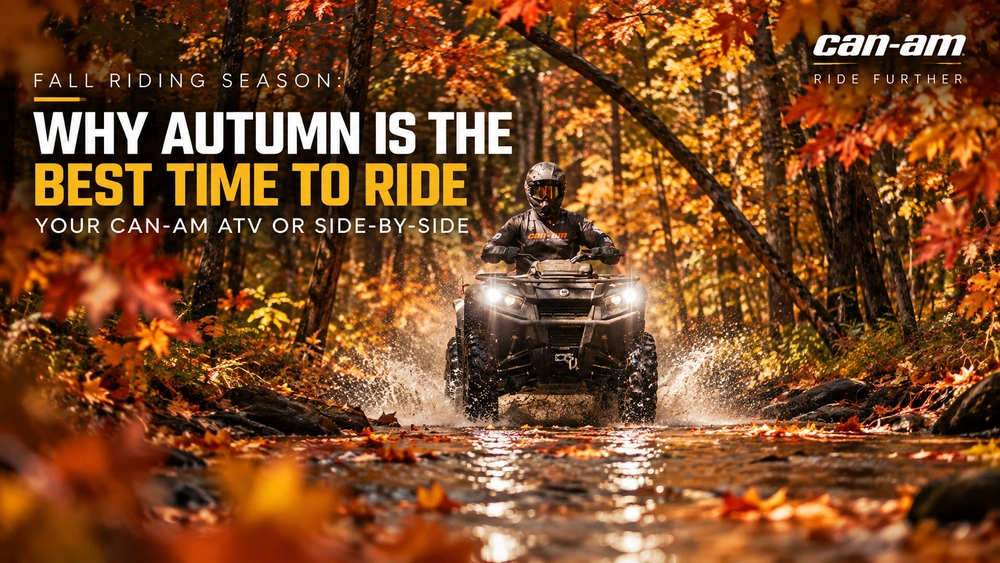
Fall Riding Season: Why Autumn Is the Best Time to Ride Your Can-Am ATV or Side-by-Side
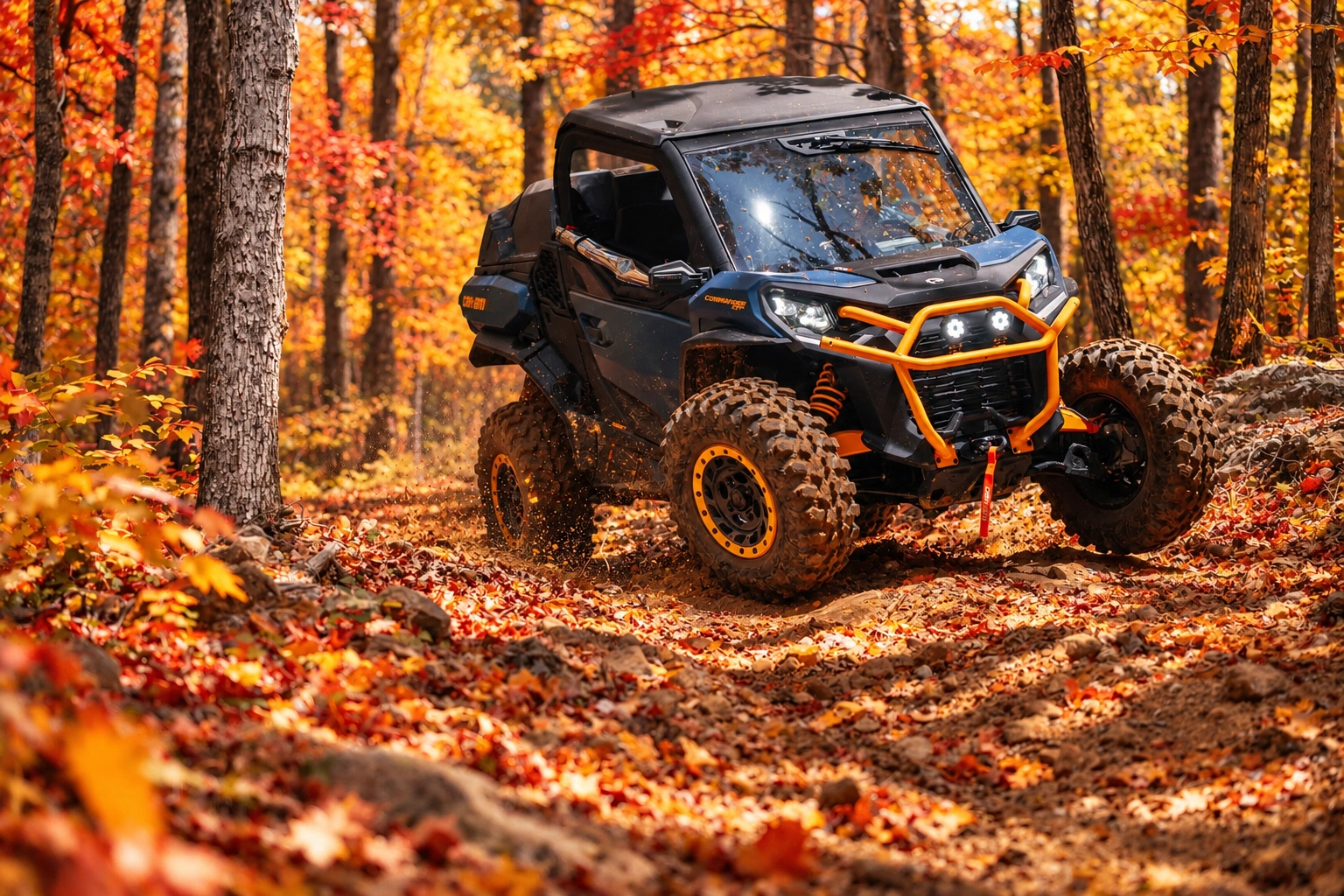
Summer gets all the hype, but ask any experienced rider which season they actually look forward to most, and a lot of them will say fall. The heat breaks, the bugs disappear, the trails firm up, and the woods turn into a tunnel of red and gold. Whether you're on an Outlander, a Renegade, a Maverick or a Defender, autumn is when a Can-Am off-road machine really gets to show what it can do.
This guide walks through why fall riding conditions are different, how to gear up and prep your machine for the season, which Can-Am models suit different kinds of fall riders, and how to keep riding safely as daylight shortens and temperatures drop — with a look at what fall riding looks like for riders around our two dealership locations in Oakville and Collingwood.
Why Fall Trail Conditions Are Different
Trail conditions shift more in fall than in any other season, and understanding why helps you plan better rides.
Firmer, more predictable terrain. Summer heat bakes trails hard or turns them to dust, while seasonal fall rain works dirt into a firmer, more consistent surface without turning it into a mud pit. That means better traction under acceleration and braking, on an Outlander climbing a rocky grade or a Maverick pushing through a tight, technical trail.
Cooler, denser air. Combustion engines make more power in cool, dense air. Riders regularly notice their machine feels crisper in October than it did in July — whether it's the Rotax HD10 in an Outlander or the turbocharged engine in a Maverick X3. Cooling systems also work less hard, which matters on long climbs or slow technical sections where a radiator gets tested.
Fewer bugs, less dust. Anyone who's ridden through a summer swarm of deer flies knows fall riding is simply more pleasant. Lower humidity and cooler air mean less dust kicked up behind you and by other riders — a real difference on group rides.
Quieter trails. Many riders put their machines away once school starts, so fall trail systems tend to see noticeably less traffic than peak summer weekends. Less traffic means fewer bottlenecks, less waiting at tight sections, and more room to actually enjoy the ride.
Shorter days and colder nights. The trade-off is daylight. Trails that felt endless in June can run out of light fast in late October, and temperatures can swing 20 degrees between a sunny afternoon and a cold, clear evening.
Matching the Machine to Your Fall Riding Style
Fall riding covers a wide range of terrain and purposes, and Can-Am's off-road lineup is built around exactly that kind of variety. You can browse current inventory and trim availability anytime at energypowersports.ca. Every model year, BRP updates trims and feature packages, so exact specs should always be confirmed with the dealership before purchase — but the framework for choosing stays consistent: power scaled to rider, terrain capability matched to conditions, and comfort features layered in for longer fall days.
Outlander — The Trail and Utility Workhorse
The Outlander remains Can-Am's best-selling ATV line for a reason: it moves between trail riding, hunting, farm work and family recreation without forcing an owner to compromise.
Typical Outlander trims include:
- Outlander 450/570 — an entry to mid-level trail and utility model, ideal for new riders, property work and recreational fall trail use
- Outlander 700 — a step up in performance for riders who want more capability without moving to the top of the lineup
- Outlander XT — added suspension travel, a winch, upgraded wheels and extra protection, which pays off on rougher, rockier fall terrain where traction and ground clearance matter more
- Outlander DPS — Dynamic Power Steering, which reduces fatigue noticeably on longer fall rides when a full day on the trail means hours of steering input over varied terrain
- Outlander MAX — two-up seating for riders who want to share fall trail season with a partner, friend or family member
Not every trim is available on every engine size, and current feature packages should be confirmed with the dealership before deciding on a specific unit.
Maverick — Sport and Trail Side-by-Sides
For riders who want side-by-side stability and passenger capacity with sport-oriented handling, the Maverick line is built around agility on tight trails and technical terrain.
- Maverick Trail — compact, trail-width models built for narrow, technical fall trail systems
- Maverick Sport — a wider stance with more suspension travel, well suited to rutted, root-covered fall trails at a faster pace with more control
- Maverick X3 — the performance flagship, built for high-speed off-road riding for those who want to push harder once trails firm up in fall
Maverick buyers should weigh trail width restrictions in their riding area, since narrower trail systems often require trail-width-specific models.
Defender — The Work and Utility Side-by-Side
The Defender line is built first for hauling, towing and property work, with recreational capability layered on top — which makes it a natural fit for fall hunting season, firewood hauling and end-of-season property work.
Defender buyers typically prioritize:
- Cargo bed capacity and towing ratings
- Cab and weather protection options for cooler fall conditions
- Two-row (MAX) configurations for crew transport
- PRO-level trims for heavier-duty commercial or farm use
For anyone splitting time between fall work tasks and recreational trail riding, Defender XT and MAX trims tend to offer the best balance of utility and comfort.
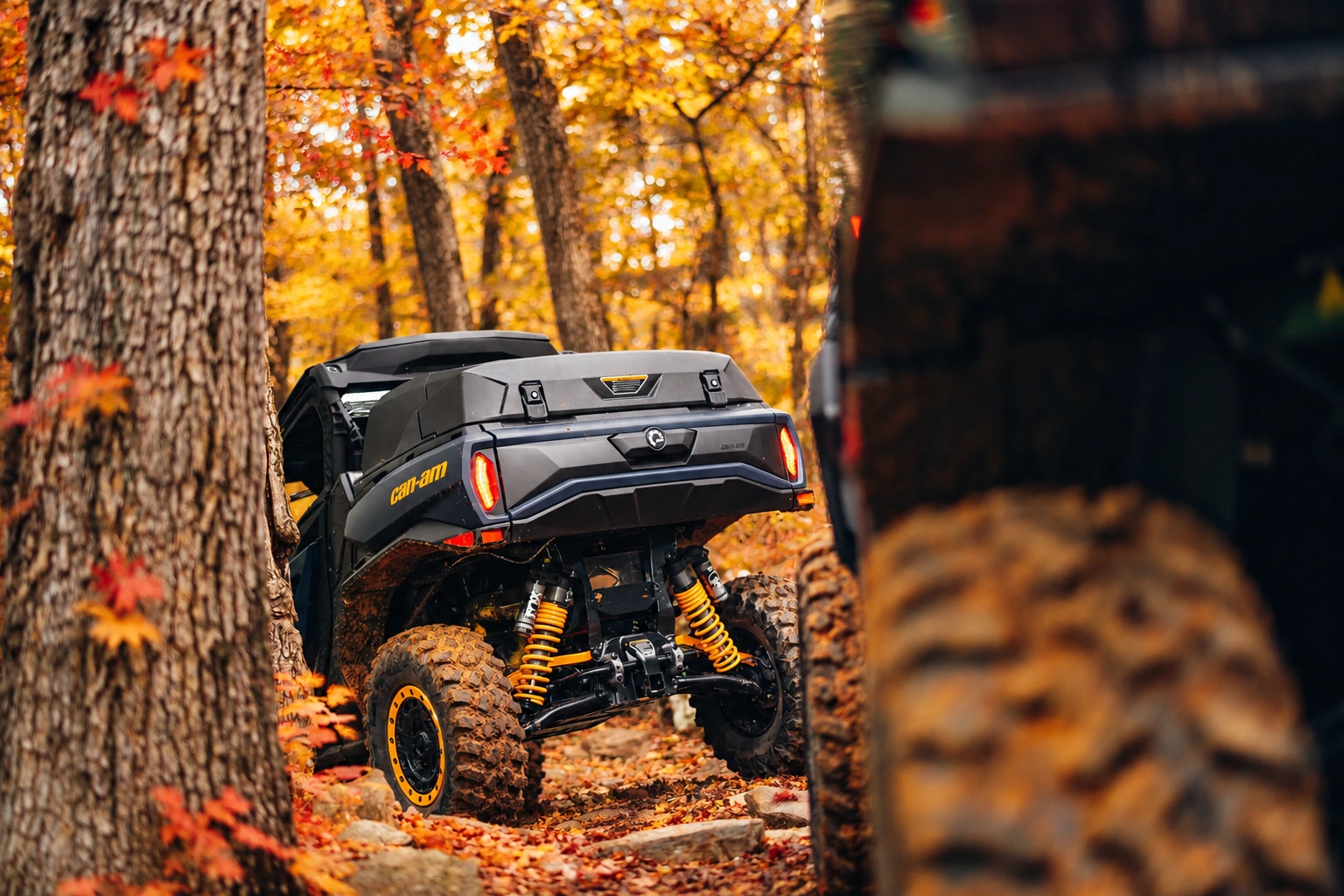
Choosing Across the Fall Off-Road Lineup: A Practical Framework
A few core questions help narrow down the right fall machine:
- How will you primarily use it? Recreational trail riding, hunting, property work and performance riding all point toward different trims and model families.
- Do you need to carry a passenger regularly? MAX configurations on the Outlander or Defender deserve consideration if so.
- What's your experience level? Newer riders generally do better starting with a lower-displacement or more forgiving trim before moving to higher-output performance models.
- How technical is your terrain? Rougher, rockier fall terrain favors XT-level capability; calmer trail systems are well served by entry and mid-range trims.
- Is rider fatigue a concern on long fall days? Dynamic Power Steering (DPS) addresses this directly on longer rides.
- What's your budget, including accessories and gear? Factor in safety equipment, winches, racks and seasonal maintenance alongside the purchase price of the unit itself.
- Does the trim you want have current availability? Confirm model-year inventory with the dealership before finalizing a decision.
Gearing Up for Fall Riding
Fall weather changes quickly, so dressing in layers matters more than at any other time of year. Riding gear, helmets and layers are all available to browse and order through shop.energypowersports.ca ahead of your next ride.
Base layer — a moisture-wicking layer that manages sweat during exertion and keeps you from chilling once you stop moving.
Mid layer — fleece or a light insulated layer for warmth that can be added or removed as temperatures swing through the day.
Outer layer — a windproof, water-resistant riding jacket. Wind chill at trail speed drops the effective temperature significantly, even on a mild day.
Hands and feet — insulated riding gloves and over-the-ankle boots. Cold hands and feet are usually what send riders home early, not cold cores.
Eye and head protection — a DOT-approved helmet, properly fitted, with a clear or lightly tinted shield for lower sun angles and falling leaves in your line of sight. A balaclava or neck gaiter under the helmet adds real warmth on cold starts.
High-visibility elements — with shorter daylight hours, a bit of reflective or high-vis gear helps other trail users see you in dawn, dusk or overcast fall light.
Essential Safety Gear for Fall ATV and Side-by-Side Riders
- DOT-approved helmet, properly fitted
- Eye protection (goggles or full-face shield)
- Riding gloves and over-the-ankle boots
- Durable, weather-appropriate riding apparel
- First-aid kit and a charged communication device for remote trail systems
Fall Trail Hazards to Watch For
Falling leaves are one of the best parts of a fall ride and one of the more deceptive hazards. A leaf-covered trail can hide ruts, rocks, roots and washouts that are easy to spot in summer. Wet leaves over rock or wooden trail bridges get slick fast — treat them like ice.
A few habits worth building into every fall ride:
- Slow down through leaf-covered sections, especially on descents or off-camber terrain
- Assume mud is hiding under any leaf pile after rain, even if the surface looks dry
- Check that your machine's headlights and taillights are in good working order — trails get dark earlier than riders expect
- Stay alert for wildlife, which becomes more active as animals prepare for winter, particularly around dawn and dusk
- Carry a charged communication device and a basic first-aid kit, especially on remote trail systems where cell service is unreliable
Getting Your Can-Am Ready for Fall
A short pre-season check-up makes a real difference once temperatures drop:
- Check tire pressure. Cooler air causes PSI to drop, which affects handling and traction — check it more often as temperatures fall through the season.
- Inspect the battery. Cold weather is hard on a battery that's already near the end of its life; a fall check now avoids a dead battery on a cold morning.
- Top off fluids. Oil, coolant and brake fluid should all be at proper levels — genuine BRP fluids keep your warranty coverage intact.
- Test all lighting. With daylight hours shrinking fast, working headlights and taillights matter more than they did in July.
- Clean or replace the air filter. A summer of dusty trail riding can leave buildup that quietly costs you performance.
- Check drive belt condition on CVT-equipped models — cold starts are tougher on a belt that's already showing wear.
If any of this sounds like more than you want to tackle yourself, book a fall service appointment before the cold really sets in. It's also the ideal window to get your machine looked at before winter storage, so small issues get caught before they turn into spring surprises — or trailside breakdowns this fall.
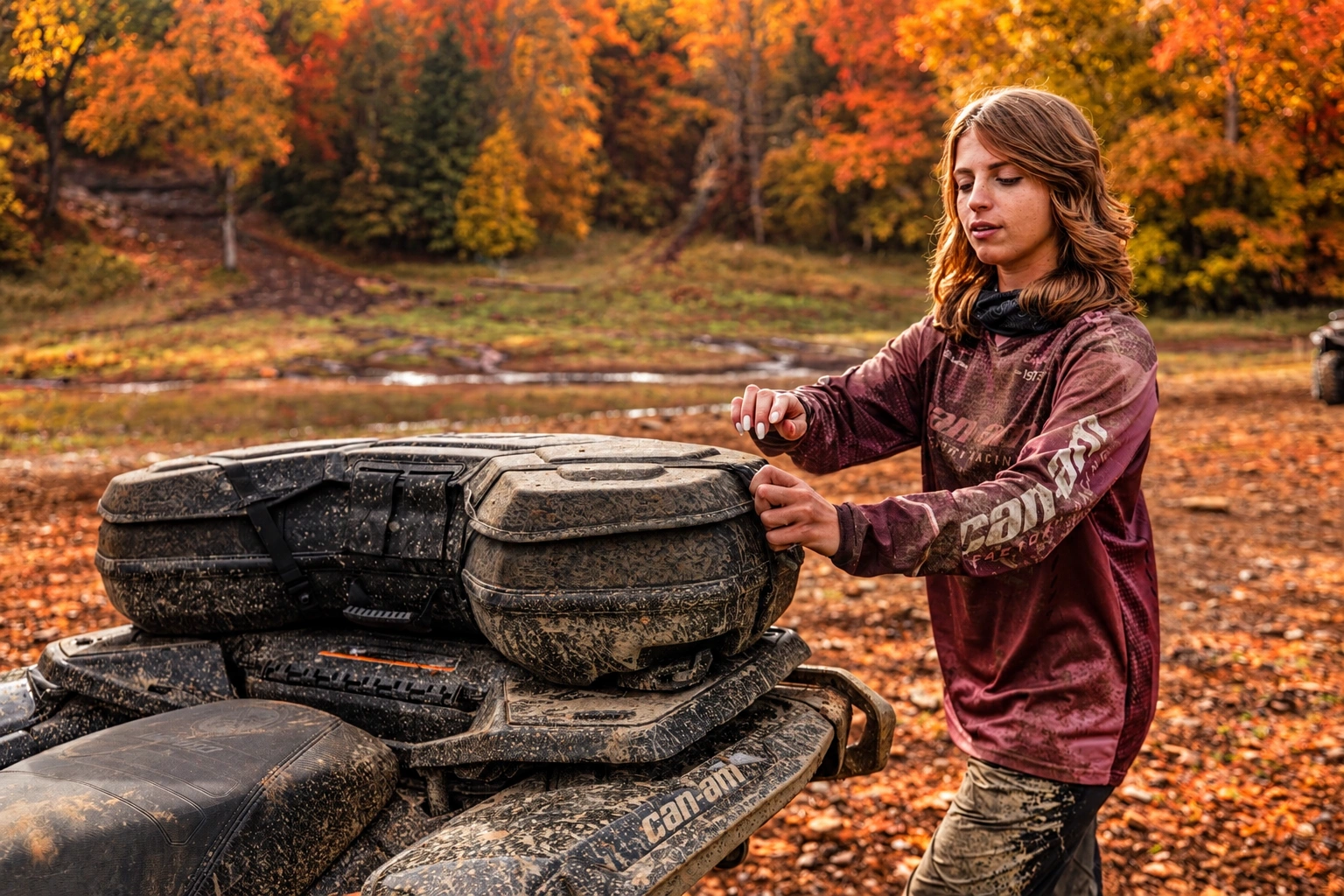
Accessories for Fall Off-Road Riding
All of the gear and accessories below are available to order ahead through shop.energypowersports.ca, so you can have what you need in hand before you load the trailer.
Trail and Technical Terrain (Outlander XT, Maverick) — Winch, skid plates, handguards, terrain-specific tires for wet and leaf-covered trails, GPS or trail navigation mount.
Work and Hunting (Defender, Outlander) — Front and rear racks, gun or bow mount, cargo box, trailer hitch, work lighting for shorter fall days.
Passenger and Family Riding (Outlander MAX) — Two-up seating accessories, extra storage, passenger-rated protective gear, protective covers for cold nights.
Genuine BRP Accessories vs. Universal Accessories
Universal accessories can look appealing because of a lower upfront cost, but genuine BRP accessories generally offer real advantages:
- Designed for the platform — engineered around specific Can-Am mounting points and ergonomics
- Better integration — model-specific parts fit cleanly without interfering with racks, storage or rider positioning
- Clearer fitment information — genuine listings identify compatible trims, model years and required hardware
- Built for the conditions — genuine accessories are engineered to handle mud, wet leaves, vibration and Canadian fall-to-winter temperature swings
This doesn't mean every universal product is a poor choice — it means fitment, durability and build quality should be evaluated carefully rather than choosing on price alone.
Recommended Fall Riding Packages
Fall Trail Package (Outlander 450/570) — DOT-approved helmet and eye protection, riding gloves and over-the-ankle boots, weather-resistant riding jacket, protective machine cover for cold nights.
Technical Terrain Package (Outlander XT) — Winch, skid plates, handguards, terrain-specific tires for wet and leaf-covered trails.
Fall Hunting and Property Package (Defender) — Front and rear racks, gun or bow mount, trailer hitch, work lighting for shorter fall days.
Passenger Fall Riding Package (Outlander MAX) — Two-up seating, extra storage accessories, passenger-rated protective gear for both riders.
Performance Package (Maverick X3) — Upgraded suspension components, performance tires, full protective gear for riders pushing harder once trails firm up.
Chase the Colour
If you want to build a ride around the season itself, plan a route through an area known for strong fall foliage. Higher-elevation trails tend to peak earlier than lower ground, so timing matters if you're after that full tunnel-of-colour experience. Many regional trail associations post foliage updates through September and October — worth checking before you load the trailer.
Fall Riding Near Our Oakville and Collingwood Locations
With dealership locations in both Oakville and Collingwood, riders across the GTA and up into Georgian Bay country have easy access to fall trail riding — and Collingwood in particular sits right in the middle of some of the best off-road terrain in Southern Ontario.
That part of the province sits at the crossroads of a few connected OFATV (Ontario Federation of ATV Clubs) trail systems, which means Outlander, Renegade, Maverick and Defender owners get a genuinely linked riding region rather than one isolated trail:
- Central Ontario ATV Club (COATV), based out of Wasaga Beach, maintains a large mapped trail network through the Simcoe County Forest, including a substantial stretch of off-road bush trail within easy reach of Collingwood.
- Dufferin Grey ATV Club (DGATV), just south and west of the Blue Mountains, maintains an extensive trail network across Dufferin and Grey counties, with a scenic core route looping through Flesherton, Ceylon, Holland Centre and the Beaver Valley near Eugenia — some of the most photographed off-road terrain in the region, especially once the fall colour turns.
Riding these systems requires a valid OFATV trail permit, and route maps are available through the QuadON trail app before you head out.
For riders local to Collingwood, that trail access is right on your doorstep. For Oakville-based riders, it's a manageable day-trip or weekend run north — get the machine serviced at whichever location is closer, trailer up, and spend the day working through the Simcoe County Forest or the Dufferin/Grey trail network. Both locations can handle pre-season maintenance and trip-readiness checks, so wherever you're starting from, tires, lights and fluids get looked at before you're relying on the machine out on trail.
Frequently Asked Questions
Is fall actually better for ATV and side-by-side riding, or is that just a preference thing? There's a real mechanical case for it — cooler, denser air improves combustion efficiency, and firmer trail conditions improve traction compared to dusty summer trails or spring mud. Preference plays a role too, but the conditions genuinely change.
Do I need to change my tire pressure for fall riding? You don't need special fall tires in most cases, but check pressure more frequently — PSI drops as ambient temperature drops, which affects handling if it goes unchecked.
What's the biggest hazard specific to fall trails? Wet leaves over rock, roots or wooden trail features. They're far more slippery than they look and are one of the most common causes of a lost-traction moment on an otherwise dry-looking trail.
How late in the season can I keep riding? That depends entirely on your region and trail system conditions, but shorter daylight hours and dropping temperatures mean most riders start adjusting ride times earlier in the day as fall progresses.
Should I service my machine before winter storage or wait until spring? A fall service check catches issues — battery health, belt wear, fluid levels — while parts and appointment availability are easier to come by than in the spring rush, and it protects the machine through winter storage either way.
Which Can-Am is best for someone who wants to ride trails now and haul firewood or gear later this fall? A Defender balances both well, with real cargo and towing capacity alongside enough trail capability for recreational riding.
Do I need a permit to ride the trails near Collingwood? Yes — trail systems in the area are maintained by OFATV member clubs like COATV and DGATV, and riding them requires a valid trail permit, which you can obtain through the QuadON app or the clubs directly.
Do you have a store in Collingwood, or just Oakville? Both — we have dealership locations in Oakville and in Collingwood, so riders can get service, parts and support from whichever is closer to home or to the trail.
Do I need a winch on my ATV or side-by-side? A winch isn't mandatory, but it's a valuable addition for riders who frequently encounter mud, deep terrain or recovery situations after fall rain. XT trims typically include one standard.
Can I finance a Can-Am off-road unit? Yes. Financing options are available — contact the dealership to discuss current programs and eligibility.
Visit Us
Oakville — 879 Cranberry Court, Oakville, Ontario. Call 905-901-5500.
Collingwood — 180 Mountain Rd, Unit 101, Collingwood, Ontario, L9Y 3Z9. Call 705-532-2277.
Get Trail-Ready This Fall
Fall is a short window, and the best trail conditions of the year don't last. Whether your current machine needs a pre-season check-up before a trail day or you're thinking about stepping up to an Outlander XT, Maverick, or Defender before the season's best weather passes, now is the time.
Explore current Can-Am inventory and trims at energypowersports.ca, book fall service, or stop by our Oakville or Collingwood location to talk through what fits your riding style before the snow flies.
